Showing posts with label work clothing. Show all posts

When I worked in downtown San Francisco, about once a week I would sneak away for a long lunch and walk from the Embarcadero Center through the maze of weird and strangely peaceful condominiums near Walton Square over to Jackson street and walk up through the old Barbary Coast. There was a cramped little store on Grant Street called "Al's Attire" which (back then) seemed like something lost in time: a tiny custom tailor shop crammed with ready-to-wear pieces made from vintage one-of-a-kind fabrics and based on vintage patterns. Before we left the city, I had Al make my wife an incredible long winter coat that she still wears and gets crazy compliments on all the time. I'm not a big shopper or a big spender, but when I do spend money (especially when traveling) I like to spend it on unique items that I can't get anywhere else. It only costs a little more to buy a coat from a place like Al's than from, say, Macy's, but when you do you know you're getting something designed and made right there in San Francisco by skilled workers being paid fairly, tailored to the highest quality. You're not buying a coat that you'll throw away after a season or two.

On our recent trip to the city, I stopped by Al's and was amazed to see he'd moved a few storefronts down into a fantastic new space. It seems he has started to focus more on menswear in recent years, especially vintage-style workwear (my favorite). I went in hoping to buy a hickory-stripe jacket he makes for the Japanese market, but decided to buy it in a gray herringbone instead. Al let me wander around and take some pictures while the saleswoman readied my purchase:


Since we last visited, Al has started making some really beautiful hats and footwear as well. I loved the look of these boots:


Every piece of clothing Al sells has a custom label with the customer's name sewn into it. On the wall, he's got a huge display of many of the custom labels he's made over the years:


This is the jacket I purchased, but in gray:


I'm still not sure I shouldn't have bought it in hickory stripe. I almost bought a pair of overalls too, but I had to restrain myself. They were based on a 1930s pattern and I didn't get a shot of them, but they were incredible (if impractical for my soft-hands lifestyle).


Al remembered the coat he made my wife, and said he made several others from the same fabric for a store in Paris where he said they sold out quickly. When the store owner wanted more, he couldn't make any because he'd run out of the vintage fabric and Al said he knew he must be doing something right if he was getting sworn at in French over the phone.

The new space is beautifully designed and definitely worth a visit if you find yourself in North Beach/Chinatown.

Photo
This blog is intended solely to share the things I come across that inspire me. If I have posted a copyrighted image, I have only done so to the extent necessary to comment upon or discuss it; I will always include a link to the original source of the image if that source is online or acknowledge the source if it is in print. If I have reproduced anything of yours here that is copyrighted and you want me to remove it, please do not hesitate to contact me and I will do so right away.


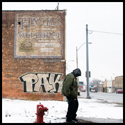
I came across two vibrant-colored ghost signs on the side of a storefront restorationist church where the building next door had recently been demolished. I believe they date back to the 1910s or the 1920s. This is one of the strange pleasures of a city where demolition is so rampant and necessary: sometimes secrets of history reveal themselves.


"Honor Bright"was a division of the Reliance Manufacturing Company that made kids' clothes and advertised in Boy's Life Magazine. The term "honor bright" itself is an anachronism that meant something along the lines of "it's the truth!" or "Scout's honor!"


I did a bit of digging to find out more about the Reliance Manufacturing Company of Chicago, sort of along the lines of what I did after seeing the Finck's Overalls sign a couple years ago. What I found was pretty interesting. The Reliance Manufacturing Company was founded by Milton F. Goodman in 1898, with its first plant in Michigan City, Indiana. The company produced work shirts under the Milton F. Goodman and Black Beauty labels, and after manufacturing many uniforms for the U.S. Army in WWI, the company started making shirts under the "Big Yank" label (I own a couple vintage Big Yank work shirts myself). According to this article, Reliance shirts were marketed heavily to farmers. With time and the success of the Big Yank label, the products were diversified to include women's dresses, men's and boys' dress shirts, pajamas, and sportswear (distributed under the brands Honor Bright, Happy Home and Kay Whitney Dresses, Awyon Shirts, Pen-rod Boys' Shirts, Universal Pajamas and Shirts, No-Tare Shorts, Yankshire Jackets and Coats, Ensenada Sportswear and Slacks). With such growth, new factories were opened in Yorktowne, Pennsylvania, Loogootee, Mitchell, Kokomo, Seymour, and Columbus (all in Indiana) Washington, D.C., Hattiesburg, Mississippi, and Montgomery, Alabama. Those factories became famous for the innovative use of recorded music piped into the garment-manufacturing floors, which was said to increase production (here is an article from a 1943 issue of Billboard Magazine about that topic). But despite the positive press for this innovation, there is a dark side to Reliance's history of manufacturing.


In looking into the history of this company, I was surprised to learn of a controversy from a hundred years ago that largely mirrors many of the current concerns with the garment manufacturing industry and third-world sweatshops. It appears that many companies manufacturing clothes after the turn of the century---mainly those making clothes for sale through large catalog retailers or national chains---used deeply-discounted prison labor as part of their manufacturing processes. Reliance was famously one of those companies.

In a hearing before the House Committee on Penal Labor in 1910, it was stated that the company employs as many as 1,100 convicts. Many of those workers were in the Michigan Penitentiary at Jackson, Michigan. The company defended itself by stating that it employed as many free laborers as it did convicts. The records of that hearing are extensive and interesting and available here. Ms. Florence Kelly, an anti-penal-labor activist, wrote that, "Milton F. Goodman was notorious in Chicago and elsewhere as the exert combination of advertised patriot and philanthropist, and terrible exploiter of prisoners. . .The Reliance Manufacturing Company was then, as it is now, the most widely ramified exploiter known to me in this field."


In 1924, at the request of the Joint Committee on Prison Labor of the Union-Made Garment Manufacturers' Association of America and the United Garment Workers of America, Labor Activist Kate Richards O'Hare conducted a nationwide survey of the prison-labor system. Her findings, published here, are pretty interesting, particularly today in the context of a global economy where labor conditions in particular factories or countries are uncertain, and where it can be downright confusing how Old Navy can sell a brand-new pair of adult blue jeans for $7.99 or whatever. Here are some important passages:

"Convict labor has been concentrated to a very large degree in the production of work garments, and in 1923, twenty states employed all, or a very large share, of their convicts in this industry, and all but four of the others to a lesser degree. One single prison labor contracting firm, in 1923, produced in the seventeen prison factories it controls, about 16,000,000 work shirts. Other smaller operators combined produced as many more shirts, and in addition millions of overalls, childrens’ play-suits, underwear and women’s house-dresses. All of these millions of garments were sold in the open markets in competition with the goods produced by free labor and manufacturing carried on under normal business conditions. The exploitation of convict labor is the most richly tax-subsidized industry in existence. The taxpayers of the several states provide the funds to build expensive prison plants. It is doubtful if any state has less than $1,000,000 invested in prison plants, and such investments run up to $10,000,000 in some states. In these astoundingly expensive prison plants the presumed function of penal institutions is entirely overlooked and ignored, and quite overshadowed by what should be merely incidental in penal administration. Where the exploitation of convict labor is carried on for private gain the prisons are not operated to treat or cure, reform or educate criminals, or to send them back to society better fitted for decent citizenship. The primary object is to produce profits for private interests. The interests and welfare of the convicts and of society are given no intelligent consideration.

The normal wage paid by a legitimate manufacturer, plus his overhead expense, for the making of a dozen shirts is from $2.00 to $2.90 per dozen. The prison labor contractor pays the state fifty cents to sixty cents per dozen for exactly the same labor and overhead. Under this contract practically all of the overhead costs of production are carried by the taxpayers, and the wages paid are only about one-fifth the normal wage paid in the garment industry, thus giving the prison labor contractor the richest tax-subsidy ever enjoyed by any industry in the history of this country."

It is likely that that large contracting firm was Reliance Manufacturing. Those Black Beauty work shirts advertised on that building might have been "triple stitched" by murderers, thieves, and other criminals. The O'Hare study also discussed the conditions faced by convicts employed in these prison factories:

"Prisoners always work under the worst possible conditions. They are always half starved. The same politicians who sell them into chattel slavery also expend the appropriations that the taxpayers provide for the prisoners’ food, and prison food is always insufficient, for the most part spoiled and decayed, and improperly cooked and served. The prisoner eats meat that is full of maggots, dried fruit and oatmeal infested with worms, beans inhabited by weevils, and macaroni that is filled with bugs, not to mention other things not mentioned in polite society that are served in the prisoners’ food. Spoiled and decayed food can be bought for a tenth of the price of good food, it can be fed to convicts because they can not complain, and prison officials are not fussy about a few bugs and worms, more or less, when big profits are at stake. Prisoners are poisoned by bad air, prevailing prison architecture making decent ventilation impossible. They are weakened by lack of exercise, and sapped by confinement in disease breeding cells; they are harried by fear; tormented by sex hunger, and always depressed and unhappy. Among the harried slaves in every prison workshop are cripples and defectives, degenerates and tuberculars, epileptics, and dements, and only a small percentage are what, under ordinary conditions, are classed as normal." [hat tip to Your Old Pal Jim for the link to O'Hare's study]

The study should be considered in the context that the Committee on Prison Labor was made up of prominent owners of work-clothing manufacturers who did not exploit prison labor, including committee chairman Oscar Berman (president of The Crown Overall Manufacturing Co.) A. Sweet, president of Sweet, Orr & Co., Inc.; and A. E. Larned, president of Larned Carter & Co. We've already looked at how the attitude of one such employer (W.M. Finck & Co.) included using union labor and the best possible quality materials as a selling point that rings true even today (and especially important when your primary market is laborers). So it is definitely interesting to consider that a huge competitor to these companies (Reliance Manufacturing) was increasing its profits in the same way contemporary garment manufacturers do today: by finding the cheapest labor possible and exploiting it for as long as you can, then moving on to the place with the next cheapest labor. Who cares if Old Navy jeans fall apart after five wearings? The American consumer has been well trained to want a new pair by then anyways.

Well, that's kind of a downer considering how beautiful those newly-uncovered signs are. But there they sit today, their paint nearly as bright as it was in 1919 when they were first unveiled in a vibrant neighborhood full of working men and women not far from Henry Ford's Highland Park Model T assembly plant in what is now one of the roughest neighborhoods to be found in this city so deeply-ravaged by the disinvestment in American manufacturing.

***Interestingly, a Japanese company that fetishizes American workwear (Workers) recently started reproducing early Reliance Manufacturing work shirts (in Japan, presumably not by prisoners).


Photo

This blog is intended solely to share the things I come across that inspire me. If I have posted a copyrighted image, I have only done so to the extent necessary to comment upon or discuss it; I will always include a link to the original source of the image if that source is online or acknowledge the source if it is in print. If I have reproduced anything of yours here that is copyrighted and you want me to remove it, please do not hesitate to contact me and I will do so right away.


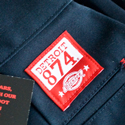
So the other day the UPS guy drops off a box addressed to me and I haven't ordered anything. I probably should have considered that suspicious (who knew what was in there? it could have been four kilos of uncut heroin or a severed human head). Inside was a pair of pants. I don't know how Dickies found me, but somehow they did. I never accept offers of promotions or giveaways from marketers, because usually they don't involve anything I'd ever be interested in using or promoting. In this case, Dickies really had my number. The pair of Detroit 874 dark navy twill work pants with red stitching was made in the USA (and this pair was only a couple inches bigger than my actual size).

Inside the box was a form letter announcing the limited-edition Detroit 874 Work Pant Program. According to the letter, for every pair of Detroit 874s sold, Dickies is donating a pair of its original 874 work pants to The Salvation Army of Metro Detroit to help workers in need. And if ever there was a community that needed help, it's this one right now. They launched the program with an initial donation of $25,000 and 5,000 pairs of new 874 work pants. Even though I don't ordinarily do this sort of thing, I thought that was pretty cool and felt compelled to share it in this space that I have used in the past to promote Detroit's history of workwear brands and other clothing Made in the USA. For more information, check out the program website.

If only Dearborn-based (and Detroit-founded) Carhartt would do something similar!


I'd been admiring Dickies' other recent Made in the USA offerings, including the 1922 Collection replica garments, and when I found them deeply discounted I picked this beautiful suntan cotton selvedge work shirt:


The clothes in this collection were made in Uvalde, TX by some of Dickies' "most experienced operators, using techniques and materials taken from the oldest garments we have, a shirt and pant that were originally purchased in 1933."


Photo
This blog is intended solely to share the things I come across that inspire me. If I have posted a copyrighted image, I have only done so to the extent necessary to comment upon or discuss it; I will always include a link to the original source of the image if that source is online or acknowledge the source if it is in print. If I have reproduced anything of yours here that is copyrighted and you want me to remove it, please do not hesitate to contact me and I will do so right away.


I wrote about Imogene + Willie back when they first released that video showing off their new retail space. I was in Nashville over the weekend and took a trip down to 12 South to see the space for myself, and (though I was in a bit of a rush) I was impressed. I've made no secret of being pretty passionate about American-made goods, and I was glad to see a store thriving with this inspiring concept of clothing produced for the consumer on site. They let me take a few pictures of the operation while hemming my new jeans:

Patterns line the ceiling, and there are rolls of denim up in the loft.
In addition to their own shirts and denim, the store stocks jeans from Levi's Vintage Clothing, RRL, and A.P.C., along with a curated selection of work boots, western-style belts, and LVC shirts and coats.
The rivets and buttons are all in these old preserve jars.
Where blue jeans are made.
Here, an Imogene + Willie employee hems my jeans [notice the vinyl of a certain Detroit export who shall remain nameless]
The workshop/store are in an old auto repair shop, and there are little acknowledgments of that here and there. . .
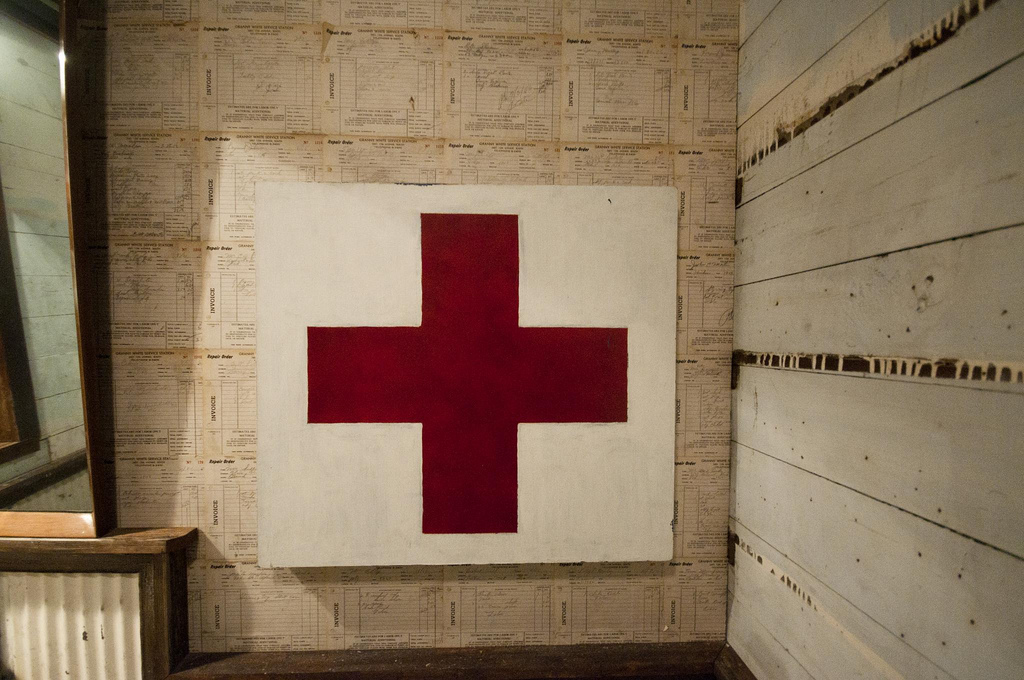
. . .like repair invoices from the old shop lining the walls of the bathroom.
I bought a pair of 13-oz raw cone denim willies. Expensive---no doubt---but if I end up wearing them like you're supposed to, I'll get more than my money's worth out of them.The following pictures are of the jeans I bought. Check out the details:


Photo
This blog is intended solely to share the things I come across that inspire me. If I have posted a copyrighted image, I have only done so to the extent necessary to comment upon or discuss it; I will always include a link to the original source of the image if that source is online or acknowledge the source if it is in print. If I have reproduced anything of yours here that is copyrighted and you want me to remove it, please do not hesitate to contact me and I will do so right away.

One of my top three favorite movies ever.

James Agee, in reviewing it, offered the effusive hyperbole he saved for those films he truly loved: "I doubt we shall ever see a film more masculine in style; or a truer movie understanding of character and of men; or as good a job on bumming, a bum's life, a city as a bum sees it; or a more beautiful job on a city. . ." It's no wonder, after that review, that Huston and Bogart worked with Agee on The African Queen (another of my favorite movies).

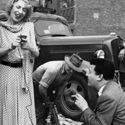
I watched Sierra Madre the other day and couldn't stop obsessing over the clothes. As summer really heats up, and most American men put on their uniforms of t-shirts and cargo shorts, the movie would have us believe that not-too-many decades ago, straight-up bums gold mining in Mexican deserts still dressed way better than we do. Look at Bogart's chambray shirt and those high-waisted pants:


I am particularly fond of Walter Huston's wardrobe; what would you bet that's a union suit? All old men should dress like that.


Photo

This blog is intended solely to share the things I come across that inspire me. If I have posted a copyrighted image, I have only done so to the extent necessary to comment upon or discuss it; I will always include a link to the original source of the image if that source is online or acknowledge the source if it is in print. If I have reproduced anything of yours here that is copyrighted and you want me to remove it, please do not hesitate to contact me and I will do so right away.


When I was in Virginia last week UVA photography professor William Wylie was in charge of looking out for me, and while I was waiting to talk to a group of students he showed me some of the equipment they use and a book of his photographs published last year, Carrara, which included some really lovely black and white photographs of the world-famous marble quarry at Carrara in Tuscany and a number of color portraits of the men who work there. When my wife and I were in Italy a few years ago her cousin from Lucca pointed out the quarries on a drive to the Cinque Terre, and he told us that the prized marble had been being extracted from the hills there since before the Roman times and that Michelangelo found the prized stone for his David there (I vaguely remembered some scene from a pre-adolescent reading of The Agony and the Ecstacy set in Carrara). Much of the late Roman forum was built of Carraran marble. And perhaps most importantly, at the beginning of the most recent James Bond movie, Bond drives his car through the quarries while avoiding the bad guys.

I recall William or someone else saying something about how the marble is nearly gone, and if so he has lovingly documented a dying industry. I really, really liked his portraits of the workers there. I have been working on a few portrait series myself behind the scenes here in Detroit and the work is much more challenging than the architectural stuff I usually do. I love the straight on, full-body portraits of the men in their work clothes, all of them coated with a fine patina of white marble dust. That's how my dad always looked after a day in the shop.

 These men are Italian, so of course there is some worthy fashion going on here (check out that pink shirt and the jaunty hat on the last guy). They sort of remind me of the early Sartorialist portraits, except these are guys I can actually admire (instead of wishing I could push them into an open manhole cover). Wylie uses an 8x10 camera and the quality and craftsmanship really shows in the actual prints. The marble makes one hell of a backdrop.


Spending weeks in the Tuscan countryside, eating, drinking, taking large-format photos of hunky Italian marble cutters in a historic location. . .how many times do you bet he's been asked how he got that gig?

Here's a short video he shot on location:


Photo


This blog is intended solely to share the things I come across that inspire me. If I have posted a copyrighted image, I have only done so to the extent necessary to comment upon or discuss it; I will always include a link to the original source of the image if that source is online or acknowledge the source if it is in print. If I have reproduced anything of yours here that is copyrighted and you want me to remove it, please do not hesitate to contact me and I will do so right away.


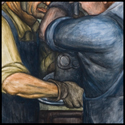
Details from "Detroit Industry" (Detroit Institute of Arts).

Also: management

Photo


This blog is intended solely to share the things I come across that inspire me. If I have posted a copyrighted image, I have only done so to the extent necessary to comment upon or discuss it; I will always include a link to the original source of the image if that source is online or acknowledge the source if it is in print. If I have reproduced anything of yours here that is copyrighted and you want me to remove it, please do not hesitate to contact me and I will do so right away.