Showing posts with label detroit. Show all posts


The incredibly colorful and vivid Faygo ghost sign above was recently uncovered on a Detroit liquor store after the neighboring building was demolished. Faygo is a soda product that has been produced in Detroit since 1907, when immigrants Ben and Perry Feigenson developed three soda flavors based on cake frosting recipes they brought over from Russia. The soda is still produced in the city at a factory built in 1935 a little more than a mile from this old sign. The bottling plant currently employs about 400 people. Faygo has always been known for its fruity soda flavors, especially red pop (strawberry). In the 1930s, Faygo began adding real orange juice to its orange flavored soda. I am going to guess (based on the font and what I was able to glean from old advertising) that this sign probably dates to the late 1930s or 1940s, before the Feigenson brothers handed over control of the company to their sons. According to legend, the company can be credited with the first use of the word "pop" to describe a soda product, as well as the invention of the twist-off cap. Today Faygo has the dubious distinction of being the official beverage of the Juggalo Nation.

When they clear the debris and remaining brick away, I'll bet that little orange down there is going to look great (it looked like one is halved). I'll try to get another picture of it before the graffiti assholes ruin this great piece of history. It was this little building that was demolished to reveal the sign after sitting vacant for as long as I've lived here, and probably much longer:


Behind that white brick wall were three ghost signs, two of which have not been completely revealed.


The second sign was for the Kowalski Sausage Company, which traces its roots to the smokehouse built in the back of Agnes and Zygmund Kowalski's grocery store on Chene Street in Detroit's old Poletown neighborhood. Today the sausages are still made in nearby Hamtramck, where the famous pierced hot dog neon sign lights up Holbrook at night, though sadly the company is considering moving from the location where it's been curing meat for 90 years to some dreary suburban industrial park. The last sign hasn't been completely revealed. All we see is the word "Ray's."


This is my third post about ghost signs here in Detroit (the second was discussed in the New York Times a few weeks ago), and in that one I said it was "one of the strange pleasures of a city where demolition is so rampant and necessary: sometimes secrets of history reveal themselves." Now I am thinking about all the ghost signs hiding behind brick walls in other (functioning) cities that may never be revealed, some of them with colors like this one. That's kind of a wonderful thought too.

Photo
This blog is intended solely to share the things I come across that inspire me. If I have posted a copyrighted image, I have only done so to the extent necessary to comment upon or discuss it; I will always include a link to the original source of the image if that source is online or acknowledge the source if it is in print. If I have reproduced anything of yours here that is copyrighted and you want me to remove it, please do not hesitate to contact me and I will do so right away.


Opened in 1887, R. Hirt Jr. closed its doors for the last time on November 19, 2011. After weathering decades of Detroit's economic upheaval to see a resurgence of life in Eastern Market, the beloved institution was finally undone by family squabbling. I don't know the details, but press releases from both indicate that one descendent of the original Hirt family owns the building and another runs the business. The building owner did not allow the store owner to renew the lease, and intends to open a new cheese store in the building under a different name. The R. Hirt Jr. Company will live on through wholesale operations at another space in the market, but the retail store's inventory was liquidated in its final days and the store's employees were given pink slips after more than 200 years of total service.

I originally profiled this store in great detail here, so that's a good place to start for the store's history and see how it looked when fully stocked.

During the final days of business for R. Hirt Jr., I was given unfettered access to document the physical space and original signage before it is (presumably) removed. When a store has been in continuous operation under the same name in the same location for 118 years, there is an incredible sense of history around every corner and a rich patina on the floors, walls, and fixtures. Needless to say, I've never shopped anywhere like this store, and our family has shopped there weekly since we moved to Detroit and we have cherished how most things there were still done the old-fashioned way. I was once again allowed into the old apartment where the Hirt family raised seven children above the store, where the original yellowed wallpaper and tin ceiling remain intact.

With the future of these spaces unknown and all this original culture of the store intact, I did my best to document as much of it as I could before the store closed last Saturday:


Thank you Judy (26 years), Jan (26 years), Ruth (15 years), Tony (5 years), Louie (33 years), Mary (20-something years), Cheryl (24 years), Andy (11 years), and Dana (who wouldn't tell me how long, but did let me take her picture) for all the cheese, and for giving my kids the memories of a store they'll be able to tell their grandchildren about.


This blog is intended solely to share the things I come across that inspire me. If I have posted a copyrighted image, I have only done so to the extent necessary to comment upon or discuss it; I will always include a link to the original source of the image if that source is online or acknowledge the source if it is in print. If I have reproduced anything of yours here that is copyrighted and you want me to remove it, please do not hesitate to contact me and I will do so right away.


We were on one of our regular trips down the Dequindre Cut to the Detroit River the other day when we noticed three beautiful paintings installed on the cement bridge foundations that are usually just covered with graffiti. It was a new experiment by the Detroit Institute of Arts's Inside|Out program, which installs ornately-framed facsimiles of some of the DIA's masterpieces outdoors in various locations in the city and its suburbs. I wrote about what is still (in my opinion) the best-executed Inside|Out piece a year or so ago, but these are pretty cool in their location, and connect the pieces installed at Eastern Market with those installed at the riverfront. I run down the cut every day, and it's been a pleasure seeing all the people stopped and staring at the paintings.

[above, Sir William Bereton, artist unknown]


[Selene and Endymion, by Nicolas Poussin]


[Konigsee, by Willibald Wex]

Photo
This blog is intended solely to share the things I come across that inspire me. If I have posted a copyrighted image, I have only done so to the extent necessary to comment upon or discuss it; I will always include a link to the original source of the image if that source is online or acknowledge the source if it is in print. If I have reproduced anything of yours here that is copyrighted and you want me to remove it, please do not hesitate to contact me and I will do so right away.


L-R: Rosemary Matteson, Lucille LeBeau, Helen Devlin, Barbara Canuana, and Dorothy Bates. I wouldn't mess with any of them if I were you (unless you're looking for a broken nose).

This was another John King find (almost as good as the last one). The original photograph was taken by Detroit News Staff Photographer H. Burgert on August 7, 1950. With the women's names and Detroit street addresses, it was simply marked "women taxi drivers."  


Photo
This blog is intended solely to share the things I come across that inspire me. If I have posted a copyrighted image, I have only done so to the extent necessary to comment upon or discuss it; I will always include a link to the original source of the image if that source is online or acknowledge the source if it is in print. If I have reproduced anything of yours here that is copyrighted and you want me to remove it, please do not hesitate to contact me and I will do so right away.

I came across two vibrant-colored ghost signs on the side of a storefront restorationist church where the building next door had recently been demolished. I believe they date back to the 1910s or the 1920s. This is one of the strange pleasures of a city where demolition is so rampant and necessary: sometimes secrets of history reveal themselves.


"Honor Bright"was a division of the Reliance Manufacturing Company that made kids' clothes and advertised in Boy's Life Magazine. The term "honor bright" itself is an anachronism that meant something along the lines of "it's the truth!" or "Scout's honor!"


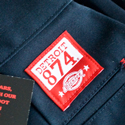
I did a bit of digging to find out more about the Reliance Manufacturing Company of Chicago, sort of along the lines of what I did after seeing the Finck's Overalls sign a couple years ago. What I found was pretty interesting. The Reliance Manufacturing Company was founded by Milton F. Goodman in 1898, with its first plant in Michigan City, Indiana. The company produced work shirts under the Milton F. Goodman and Black Beauty labels, and after manufacturing many uniforms for the U.S. Army in WWI, the company started making shirts under the "Big Yank" label (I own a couple vintage Big Yank work shirts myself). According to this article, Reliance shirts were marketed heavily to farmers. With time and the success of the Big Yank label, the products were diversified to include women's dresses, men's and boys' dress shirts, pajamas, and sportswear (distributed under the brands Honor Bright, Happy Home and Kay Whitney Dresses, Awyon Shirts, Pen-rod Boys' Shirts, Universal Pajamas and Shirts, No-Tare Shorts, Yankshire Jackets and Coats, Ensenada Sportswear and Slacks). With such growth, new factories were opened in Yorktowne, Pennsylvania, Loogootee, Mitchell, Kokomo, Seymour, and Columbus (all in Indiana) Washington, D.C., Hattiesburg, Mississippi, and Montgomery, Alabama. Those factories became famous for the innovative use of recorded music piped into the garment-manufacturing floors, which was said to increase production (here is an article from a 1943 issue of Billboard Magazine about that topic). But despite the positive press for this innovation, there is a dark side to Reliance's history of manufacturing.


In looking into the history of this company, I was surprised to learn of a controversy from a hundred years ago that largely mirrors many of the current concerns with the garment manufacturing industry and third-world sweatshops. It appears that many companies manufacturing clothes after the turn of the century---mainly those making clothes for sale through large catalog retailers or national chains---used deeply-discounted prison labor as part of their manufacturing processes. Reliance was famously one of those companies.

In a hearing before the House Committee on Penal Labor in 1910, it was stated that the company employs as many as 1,100 convicts. Many of those workers were in the Michigan Penitentiary at Jackson, Michigan. The company defended itself by stating that it employed as many free laborers as it did convicts. The records of that hearing are extensive and interesting and available here. Ms. Florence Kelly, an anti-penal-labor activist, wrote that, "Milton F. Goodman was notorious in Chicago and elsewhere as the exert combination of advertised patriot and philanthropist, and terrible exploiter of prisoners. . .The Reliance Manufacturing Company was then, as it is now, the most widely ramified exploiter known to me in this field."


In 1924, at the request of the Joint Committee on Prison Labor of the Union-Made Garment Manufacturers' Association of America and the United Garment Workers of America, Labor Activist Kate Richards O'Hare conducted a nationwide survey of the prison-labor system. Her findings, published here, are pretty interesting, particularly today in the context of a global economy where labor conditions in particular factories or countries are uncertain, and where it can be downright confusing how Old Navy can sell a brand-new pair of adult blue jeans for $7.99 or whatever. Here are some important passages:

"Convict labor has been concentrated to a very large degree in the production of work garments, and in 1923, twenty states employed all, or a very large share, of their convicts in this industry, and all but four of the others to a lesser degree. One single prison labor contracting firm, in 1923, produced in the seventeen prison factories it controls, about 16,000,000 work shirts. Other smaller operators combined produced as many more shirts, and in addition millions of overalls, childrens’ play-suits, underwear and women’s house-dresses. All of these millions of garments were sold in the open markets in competition with the goods produced by free labor and manufacturing carried on under normal business conditions. The exploitation of convict labor is the most richly tax-subsidized industry in existence. The taxpayers of the several states provide the funds to build expensive prison plants. It is doubtful if any state has less than $1,000,000 invested in prison plants, and such investments run up to $10,000,000 in some states. In these astoundingly expensive prison plants the presumed function of penal institutions is entirely overlooked and ignored, and quite overshadowed by what should be merely incidental in penal administration. Where the exploitation of convict labor is carried on for private gain the prisons are not operated to treat or cure, reform or educate criminals, or to send them back to society better fitted for decent citizenship. The primary object is to produce profits for private interests. The interests and welfare of the convicts and of society are given no intelligent consideration.

The normal wage paid by a legitimate manufacturer, plus his overhead expense, for the making of a dozen shirts is from $2.00 to $2.90 per dozen. The prison labor contractor pays the state fifty cents to sixty cents per dozen for exactly the same labor and overhead. Under this contract practically all of the overhead costs of production are carried by the taxpayers, and the wages paid are only about one-fifth the normal wage paid in the garment industry, thus giving the prison labor contractor the richest tax-subsidy ever enjoyed by any industry in the history of this country."

It is likely that that large contracting firm was Reliance Manufacturing. Those Black Beauty work shirts advertised on that building might have been "triple stitched" by murderers, thieves, and other criminals. The O'Hare study also discussed the conditions faced by convicts employed in these prison factories:

"Prisoners always work under the worst possible conditions. They are always half starved. The same politicians who sell them into chattel slavery also expend the appropriations that the taxpayers provide for the prisoners’ food, and prison food is always insufficient, for the most part spoiled and decayed, and improperly cooked and served. The prisoner eats meat that is full of maggots, dried fruit and oatmeal infested with worms, beans inhabited by weevils, and macaroni that is filled with bugs, not to mention other things not mentioned in polite society that are served in the prisoners’ food. Spoiled and decayed food can be bought for a tenth of the price of good food, it can be fed to convicts because they can not complain, and prison officials are not fussy about a few bugs and worms, more or less, when big profits are at stake. Prisoners are poisoned by bad air, prevailing prison architecture making decent ventilation impossible. They are weakened by lack of exercise, and sapped by confinement in disease breeding cells; they are harried by fear; tormented by sex hunger, and always depressed and unhappy. Among the harried slaves in every prison workshop are cripples and defectives, degenerates and tuberculars, epileptics, and dements, and only a small percentage are what, under ordinary conditions, are classed as normal." [hat tip to Your Old Pal Jim for the link to O'Hare's study]

The study should be considered in the context that the Committee on Prison Labor was made up of prominent owners of work-clothing manufacturers who did not exploit prison labor, including committee chairman Oscar Berman (president of The Crown Overall Manufacturing Co.) A. Sweet, president of Sweet, Orr & Co., Inc.; and A. E. Larned, president of Larned Carter & Co. We've already looked at how the attitude of one such employer (W.M. Finck & Co.) included using union labor and the best possible quality materials as a selling point that rings true even today (and especially important when your primary market is laborers). So it is definitely interesting to consider that a huge competitor to these companies (Reliance Manufacturing) was increasing its profits in the same way contemporary garment manufacturers do today: by finding the cheapest labor possible and exploiting it for as long as you can, then moving on to the place with the next cheapest labor. Who cares if Old Navy jeans fall apart after five wearings? The American consumer has been well trained to want a new pair by then anyways.

Well, that's kind of a downer considering how beautiful those newly-uncovered signs are. But there they sit today, their paint nearly as bright as it was in 1919 when they were first unveiled in a vibrant neighborhood full of working men and women not far from Henry Ford's Highland Park Model T assembly plant in what is now one of the roughest neighborhoods to be found in this city so deeply-ravaged by the disinvestment in American manufacturing.

***Interestingly, a Japanese company that fetishizes American workwear (Workers) recently started reproducing early Reliance Manufacturing work shirts (in Japan, presumably not by prisoners).


Photo

This blog is intended solely to share the things I come across that inspire me. If I have posted a copyrighted image, I have only done so to the extent necessary to comment upon or discuss it; I will always include a link to the original source of the image if that source is online or acknowledge the source if it is in print. If I have reproduced anything of yours here that is copyrighted and you want me to remove it, please do not hesitate to contact me and I will do so right away.

Feral House, circa. 1933

Posted by jdg | 11:32 AM |


This was a road house and inn known known as Four Mile House. Before that it was owned by a man named Francis Prevost, a French immigrant who came to Detroit in 1846, helping build a farm in the "wilds" of Wayne County seven miles from city hall. He lived on that farm until he was 23, when he operated dry goods and wholesaling concerns downtown, and after he lost his holdings to a fire he operated this house as a hotel for ten years and then moved to Saginaw where he started a soft drink company. Four Mile House, located at Crane & Gratiot, was built for a Mrs. Emilia Colquitt in 1862. I could locate no further information about her.

I'm guessing that's a 1933 Ford, so this was taken some time after that.


Photo
This blog is intended solely to share the things I come across that inspire me. If I have posted a copyrighted image, I have only done so to the extent necessary to comment upon or discuss it; I will always include a link to the original source of the image if that source is online or acknowledge the source if it is in print. If I have reproduced anything of yours here that is copyrighted and you want me to remove it, please do not hesitate to contact me and I will do so right away.


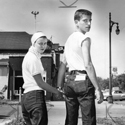
Last week there were a few thousand activists in town for a big conference on social justice and there were a few dozen protest marches crisscrossing the city. I don't really get into protests (that is, unless the issue is really close to my heart, like protecting dwarfs from angry mobs), but I'll admit it was pretty cool to see lots of young people in the usually-empty streets of Detroit. I am sure some of them caught on to the cool things happening here and hopefully some of them will come live here after their stint at Oberlin or Reed or wherever. This city, of course, has a long history of picketing and protests as the historical hotbed of worker's rights and unionism. Kids like those in the pictures above picketed right alongside their parents during strikes.

I'm not sure if this history influenced the kids in the following photos (or if kids did this sort of thing everywhere), but I love these photos of kids picketing various transgressions in their Detroit neighborhoods. The children in this photo from the 1930s are picketing the house of "Miss Uiyys" (sp?) who keeps baseballs that end up in her yard and refuses to give them back:


A few years later, a Detroit News photographer captured a similar scene; it's unclear who's been unfair to them, but judging by the mitt on the second-to-last kid in line it was likely a similar act of cruelty. I love the bemused parents watching from the porch:


These grubby little hippies are protesting high prices and encouraging some kind of boycott:


Of course, kids protesting aren't always this adorable. In addition to being a hotbed of unionism and worker protest, the dark side has been the extreme racial hostility that helped create the city we see today. That ugly side showed its face during protests over busing to desegregate Detroit's schools:

Of course, it also gave a chance for people to show a welcoming spirit and a hope for racial harmony that never panned out here. It was much easier for most people just to move to the suburbs.


All the above images were found in the Virtual Motor City Archive hosted by Wayne State University.


Photo
This blog is intended solely to share the things I come across that inspire me. If I have posted a copyrighted image, I have only done so to the extent necessary to comment upon or discuss it; I will always include a link to the original source of the image if that source is online or acknowledge the source if it is in print. If I have reproduced anything of yours here that is copyrighted and you want me to remove it, please do not hesitate to contact me and I will do so right away.